Studio retention · Founder story
The Student Who Never Speaks Up
Why the quiet gap after class is one of the reasons students leave yoga studios, and what office hours could change.
By Claire (Huong) Luu (Bjaanes) · November 6, 2026
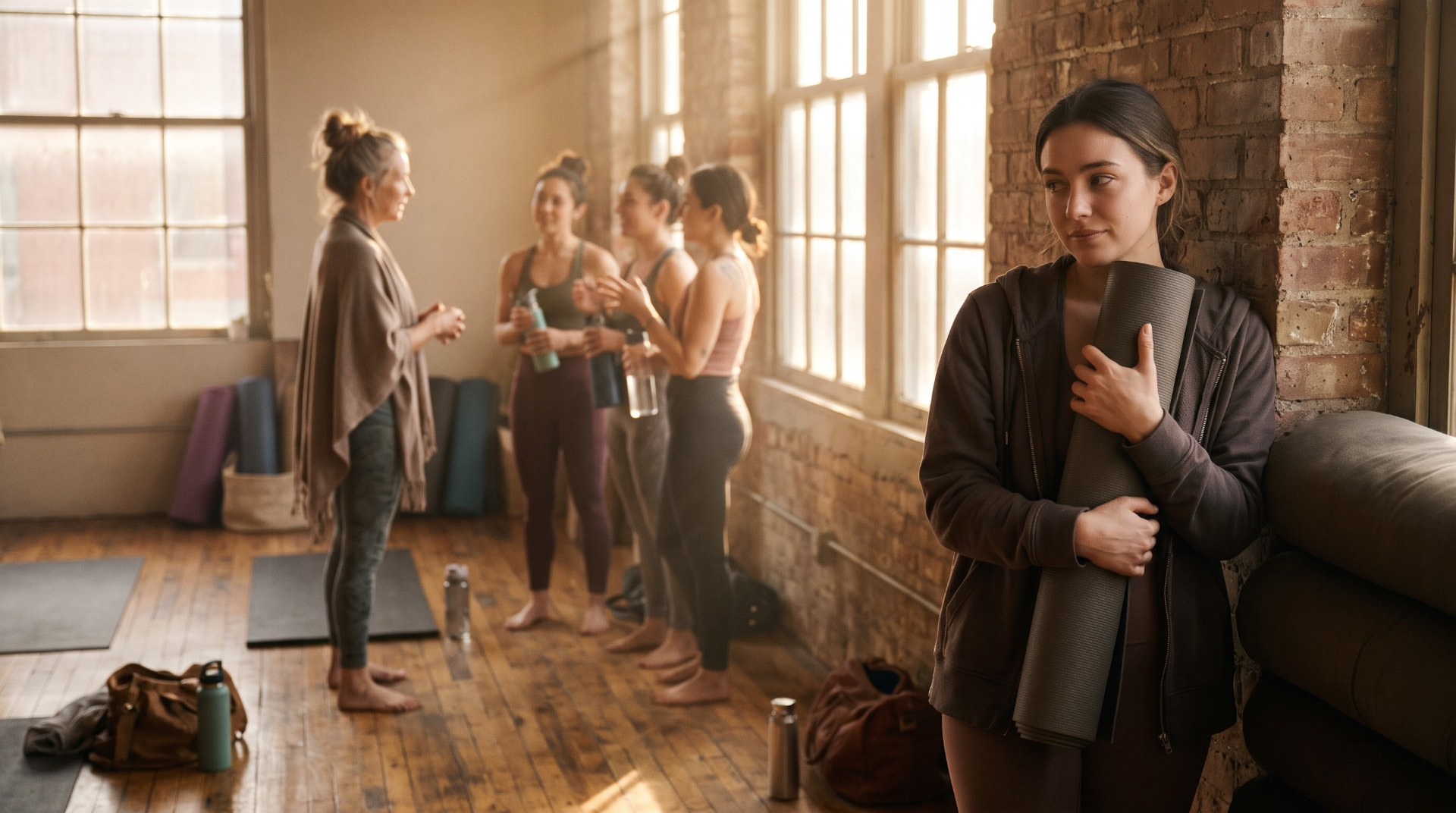
When class ends, the mats are rolled up and the room fills with small talk. Near the door, a student lingers. She has a question about her shoulder, or about the sleep that has not come for weeks. I know that wait well, because twenty years ago, I was the one standing there.
This article is about what happens in that gap, and why I believe it is one of the reasons students leave yoga studios. I teach yoga and run The Yoga Nest in Stavanger, Norway. I am also building Conscious Flow, a platform for studios that want to keep their members. I want to describe the problem as I have seen it from both sides of the mat, and from one more side I have not spoken about often.
A student who wanted to talk
When I started yoga, I wanted to talk to my teacher after class. Sometimes the teacher had a line of people waiting. Other times I was shy, and I held back. Either way, the conversation I wanted did not happen, and I went home with the question still open.
I did not leave yoga because of that. But I remember how small the moment felt, and how easily I could have walked away.
The students who did not speak up
When I began teaching, I noticed something I had not expected. The students who needed to talk to me most were usually the ones who shied away. They stood at the back, rolled their mats slowly, and left before I could reach them.
I did not have enough time to give everyone the help and support they needed. A class ends, and the teacher has twenty or thirty minutes before the next group arrives. In that time, students bring me their injuries, their sleep problems, their trouble with a headstand, and their search for exercises that might help with stress or anxiety. These are serious questions, and they often decide whether people keep coming back.
Many of those conversations continue on WhatsApp, in the evenings, long after the studio has closed.
Teaching at the university
Before I taught yoga full time, I taught at a Social Sciences and Humanities College, about twenty years ago. I taught English and PR to first year and senior students. Students came to the lectern at the end of the session with the same kind of question I had asked as a yoga student: questions that could help them improve their study.
In that setting, the answer was already built into the structure. Students knew they could come to office hours. Most of them never came, but the ones who did were often the ones who had been shy in the classroom.
I did not think about yoga at the time. Looking back, the lesson I took from the university is the same one I took from the studio: the students who most need a conversation are rarely the ones who ask for it in public.
The hours no one pays for
Yoga teachers are usually paid by the class. The rate is modest, and it covers the time in the room, not the time outside it. A student who needs a short conversation between classes is asking for time that no one has budgeted for.
A teacher has the same twenty four hours as everyone else. Much of that time goes into maintaining relationships with students, answering messages, and remembering who is recovering from what. The tools for this work, the class schedule, the messages and the notes, are not connected to each other. Each one holds a piece of the student, and none of them has the whole picture.
What churn costs
A figure often quoted in the industry is that around 60 to 70 percent of yoga students leave each year. Whatever the exact number, any studio owner will recognise the pattern. Every departing student has to be replaced, and replacing them costs money: marketing, and discounts offered for a first class.
If a studio keeps more of its students, the cost changes. Instead of constantly recruiting new people, it can focus on keeping the people it already has. That is a more efficient business, and a better place to teach.
Office hours for the yoga studio
The idea that shaped Conscious Flow comes from something I already knew from my days teaching at the university. Universities give students office hours, a fixed time when they can bring their questions to a teacher. I taught in that system, and I saw how such a space helps students who are too shy to talk with their teacher in front of others.
A yoga studio could offer something similar: short, scheduled slots of about ten minutes, where a student can speak with the teacher without standing in a line. I want the technology to make that work. Before class, the teacher could see each student's readiness, so the lesson can be adjusted in real time. After class, the teacher could give personal feedback, with smart tools to help them. The teacher still makes every decision. The software handles the preparation and the workflow, so the teacher can focus on the person in front of them.
I do not believe technology should or could replace the teacher, but it can give the teacher back some of the time the current system takes away.
Back at the door
The student is still there, waiting for the gap. In the studio, the teacher already knows what she came to ask, and the conversation can happen on a schedule that both of them chose. I did not have that twenty years ago. I think every student deserves it now, with Conscious Flow.